

 Last Updated: November 21, 2025

20 May
Abstract
Nowadays, businesses adopt different strategies to provide excellent services to their customers while ensuring high-level quality. Businesses implement quality monitoring processes to understand the operational progress and to reshape the customer experience. As customer expectations are changing continuously, a single interaction can ruin the efforts and goodwill of years. Businesses must create effective strategies to ensure that customers are provided timely issue resolutions with the utmost high quality.
Introduction
Building a reputation takes a lifetime, and it only takes a few seconds to destroy. This applies to the businesses operating in the customer service industry. Every call center makes sure that it provides outstanding customer experience (CX) to promote long-term relationships. However, a single bad experience could drive the customers away. This gives rise to the concept of call center quality monitoring (QM).
Call center quality monitoring (CCQM) ensures that as a service provider, you’re responsive to the customer’s needs and offer quick resolutions. To enhance customer interactions, the managerial team implements various strategies and ensures quality services.
Quality Monitoring (QM)
QM is a process that focuses on customer interaction alignment with the set business goals. QM identifies the customers’ issues, improves customers’ experience, and establishes a set communication process with loyal and new customers.
QM in call centers helps improve the agents’ performance and enhances the customers’ satisfaction level. If the interactions are of utmost quality, the volume (handling time) decreases, and the key indicators like CSAT (Customer Satisfaction) and NPS (Net Promoter Score) increase.
According to Future Market Insights’ article ‘Call Center Market’, the industry is valued at $37.4 billion in 2025 and is expected to grow with a CAGR of 7.4%, reaching $76.4 billion in 2035 (i).
What is Quality Monitoring (QM)?
In the call center industry, QM is a process that focuses on assessment of customer interactions that occurred on calls, mails, and chats to ensure that agents follow the set guidelines and standards. QM identifies the customers’ issues, improves CX, and establishes a set communication process with loyal and new customers. Such assessments include evaluating agent performance, monitoring omni-channels, and tracking KPIs.
QM in call centers helps improve the agents’ performance and enhances the customers’ satisfaction (CSAT) rates. If the interactions are of utmost quality, it reduces the handling time and enhances the key indicators like CSAT and NPS (Net Promoter Score).
Genesys, in its report ‘The State of Customer Experience,’ stated that about 82% of the customers consider a business as good as its services (ii).”
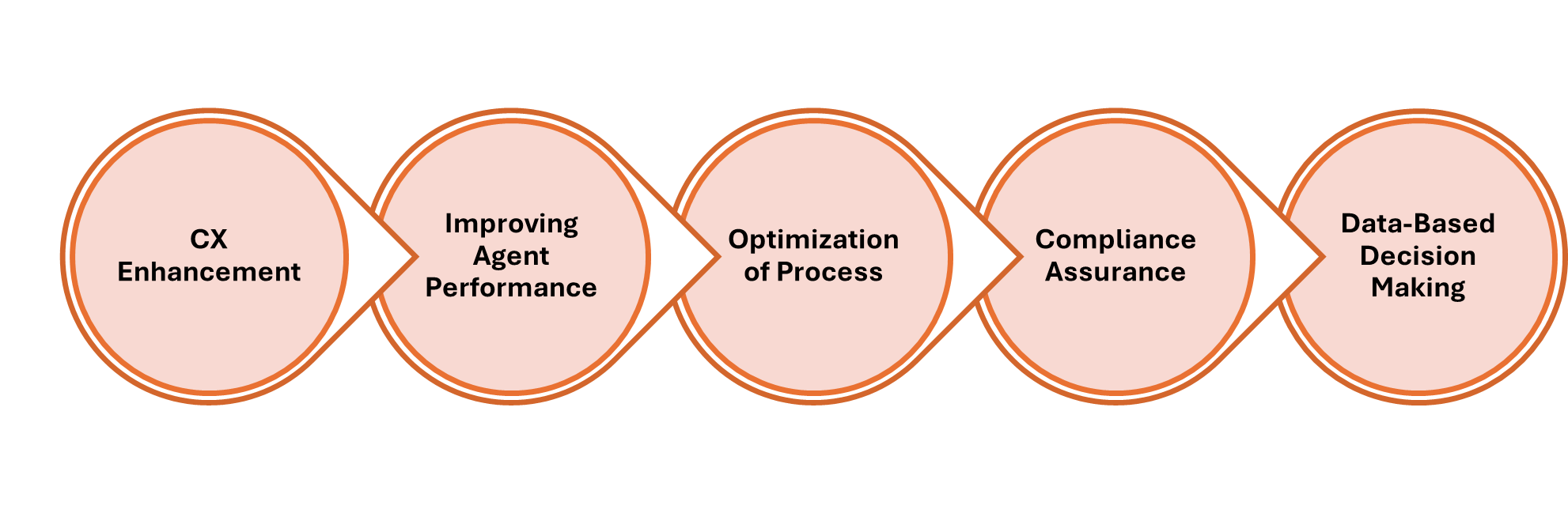
Core Objectives of Call Center QM
These objectives display the strategic intentions that lie behind the implementation of the QM process. These objectives are business-driven and we’ve prepared a list of main objectives:
Functions of Call Center QM
QM fulfills various aspects of interrelated operations that focus on promoting quality services and excellence. These functions are just activities aimed at reaching the set goals. These functions include:

Roadmap for the CCQM Process
To ensure effective implementation of the CCQM process, we’ve created a roadmap that outlines a detailed plan, i.e.,
| Phase | Goal | Key Deliverables |
| Phase 1: Planning & Framework Design | – Define quality objectives.
– Identify KPIs. – Establish Quality Standards. |
– It focuses on quality policy, scorecards, and KPIs. |
| Phase 2: Process Setup & Calibration | – Create Monitoring Guidelines.
– Establish training programs for quality analysts. – Start a pilot run. |
– It aims to calibrate the QA teams and deliver pilot test outcomes. |
| Phase 3: Monitoring & Data Collection | – Select Interactions for call review.
– Assessment of Customer Interaction. – Identifying documents and verifying scores. |
– This phase provides performance records and assessment outcomes. |
| Phase 4: Feedback & Coaching | – Deliver real-time feedback.
– Implement the SBI (Situation, Behavior, and Impact) Model. – Self-assessment of agent. – Create Individual Development Programs (IDPs). |
– This phase provides regular training sessions, ensures follow-ups, and supports IDPs. |
| Phase 5: Reporting & Analysis | – Develop QA reports.
– Integrate CX metrics & QA. – Conduct Root Cause Analysis (RCA). |
– This phase includes delivering regular QA reports and root cause results. |
| Phase 6: Continuous Optimization | – Implement Corrective Actions.
– Updating QM guidelines. – Implement advanced technologies and analytics. |
– This phase ensures provision of updated forms, detailed dashboards, and advanced technologies. |
Salesforce’s ‘The State of Connected Customer’ report states that 43% of the customers stop buying from a brand due to bad customer experience (iii).”
Challenges in Implementing the CCQM Process
The CCQM process includes calibration of technologies, human resources, and processes. As we’ve learned that the implementation of a CCQM process offers several benefits, it also attracts various challenges. These challenges are as follows:
Inconsistent Assessments:
The first challenge of the CCQM process is inconsistent quality across the operations. It is totally dependent on the perception of the QA analysts, as different persons evaluate the scoring rubrics differently. This results in:
- Subjective Interaction Assessments;
- Scoring Disturbances;
- Human agent trusts the process even less;
- Unreliable datasets.
“According to Salesforce’s ‘The State of Service’ report, maintaining a balance between fast customer service and good quality is difficult for about 69% of the agents (iv).”
Integration and Technology Gaps:
Companies handling customer services may use outdated technologies and obsolete systems that can impact streamlined operations of the call centers. This includes difficulties in retrieving calls, lack of real-time monitoring, limited reporting, and manual processes.
Failure to Improve Continuously:
Various QA processes are implemented and operated in silence, ultimately failing to provide a detailed perception of business operations.
Ineffective Practices:
Various organizations face issues with timely implementation of effective practices. Basic issues involve late feedback, single-sided training interactions, and lack of guidance, leading to bad customer experience.
“Capgemini’s ‘Unleashing the Value of Customer Service’ report states 39% of the customers tolerate the problems, as they’ve to go through a complex customer service process (v).”
Resistance & Low Engagement:
CCQM may include internal resistance when frontline agents feel the system is not developmental, lacks transparency, and highlights liability rather than enhancements.
Obsolete Scorecards:
Scorecards hold an essential place in CCQM; however, they are considered obsolete if not designed properly. Sometimes, these cards can be complicated, misaligned, not updated, and may focus overly on compliance.
Insufficient Time and Resources:
The QM process requires adequate time and resources. Without proper resource and time management, companies may face low monitoring coverage, overburdened analysts, inconsistent execution, and irregular training.
Best Quality Monitoring Practices
Since all the call centers run on their unique business model and approach, it is essential that specified practices are followed to align with your business requirements and goals.
We’ve listed some of the best practices that help in optimizing the CCQM process, ultimately enhancing the overall quality.
1. Self-Assessing Your Current Position
To enhance QM, businesses must know where the customers’ interest lies and where the company stands. This means companies must perform self-assessments to know their current position. This provides an insight into internal operations, allowing the businesses to move forward accordingly. Customer feedback and market analysis can highlight the improvement areas. Moreover, businesses can hire third-party agencies to get unbiased reviews and meet the desired goals.
“The Salesforce report ‘The State of Service’ revealed that 49% of the interactions were excellent, 43% were good, and 8% were fair or poor (iv).”
2. Developing a Strategy
After self-assessment, businesses must create effective strategies and must follow such strategies without failure. This requires collecting a huge load of data and identifying the adversely affecting performance metrics. The goal here is to establish effective strategies and enhance the overall performance.
3. Call Recording and Monitoring
It is well established that support services are mainly customer-centric and businesses must listen to their customers. For this, call centers must record and monitor the customer-agent interactions and must ensure that quality services are provided. With the implementation of CCQM, quality analysts keep track of performance metrics and provide regular feedback to the customers. This improves the average handling time, occupancy rate, satisfaction rate, and first-call resolution. It provides a clear overview of the best and worst customer calls.
4. Adopting Latest Technologies
To ensure delivery of quality services, businesses must implement the latest and most advanced technologies, like speech analytics and chatbots. It is noted that various call centers operate on old technologies and systems. Advanced technologies offer real-time call monitoring and provide instant feedback. With this, supervisors can establish effective training programs and create better call scripts for customer interaction.
“The customer service benchmark report by Freshworks states that only 32% of the support service providers are using advanced technologies like AI (vi).”
5. Make one person/team accountable to manage the QM process
Different business operations require different skills, and it becomes difficult for a single person to handle issues of different natures. This applies to the QA process as well. Businesses must appoint or hire separate teams to implement and handle CCQM. Moreover, businesses must provide special authority to take effective measures like coaching sessions or call monitoring to improve the quality.
In simple words, the QM team and analysts can offer real-time support to the agents, ultimately improving their skill sets and enhancing the satisfaction rate.
6. Sticking to the Best Call Scripts
Call scripts play a crucial role in delivering high-quality services. Today’s customers want personalized and quick issue resolutions. With advanced technologies, agents can get access to past customer transactions, their behavior, and their emotional level. This provides a heads-up to the agents on how to interact with a specific customer and have their scripts ready. Utilizing the most worked scripts can create a good impression on customers, help in receiving feedback, and improve the overall quality. Involving the employees in creating the scripts may also help move the mountain.
7. Have Some Room for Dispute
The call center must offer little room for agents to dispute the feedback received from the customers. Instead of blaming everything on the agents, it is significant to understand the situation and proceed accordingly. This gives voice to the agents, ultimately enhancing their involvement and engagement. This will be considered just and wise to develop the QM practices. Such authority allows the call center agents to improve their skills, leading them to handle such situations like a pro. This allows the call center agents to monitor their performance from time to time.
“According to Gallup’s ‘Employee Retention & Attraction’ article, engagement and working culture are the common reasons for 37% of the workers leaving the companies (vii).
NEQQO to the Rescue
NEQQO is an advanced platform that helps in managing quality, providing business insights, and promoting advanced reporting for the call centers. This platform brings the best of two worlds together, i.e., human-assisted and automated assessments. This AI-based quality management solution includes monitoring, optimizing, and providing feedback. NEQQO offers various features, which include:
- AI-based call summarization;
- Auto-QA through AI;
- Flagging compliance violation;
- Smart Redaction;
- Track Key Performance Indicators (KPIs).
NEQQO, with its unified dashboard, not only improves the QM process, but it also provides access to the company’s performance by tracking all essential metrics, offering timely feedback, and enhancing the agent performance as well as the customer experience.
Conclusion
QM is a process that includes continuous monitoring, generates valuable insights, and tracks the performance metrics to meet the desired objectives and deliver quality services to the customers.
To implement the QM process effectively, businesses must adopt the strategies we recommended, including self-assessments, strategy creation, using advanced technologies, and so on. To improve the shortfalls and uplift the customer experience, businesses can also adopt a digital and advanced platform with a unified dashboard, i.e., NEQQO.
Frequently Asked Questions
1. What types of interactions are monitored in CCQM?
In the call center industry, various customer interactions are monitored across multiple channels, including:
- Voice calls
- Emails
- Chat conversations
- Social media
2. What are the core objectives of the CCQM process?
The CCQM process serves several key objectives, such as:
- Enhancing customer experience
- Improving agent performance
- Minimizing errors
- Ensuring compliance with standards and guidelines
- Gathering data-driven insights for continuous improvement
3. What is the roadmap of the CCQM process?
The CCQM process typically follows six phases:
- Planning & Framework Design
- Process Setup & Calibration
- Monitoring & Data Collection
- Feedback & Coaching
- Reporting & Analysis
- Continuous Optimization
4. What technologies are used to improve the CCQM process?
Modern digital advancements have strengthened CCQM processes. Commonly used technologies include:
- Speech analytics
- Chatbots
- Call recording systems
- Advanced dashboards
5. How does CCQM lead to continuous improvement in call centers?
CCQM supports continuous improvement by:
- Identifying recurring customer queries
- Recognizing operational gaps
- Providing actionable insights through analytics
- Delivering regular feedback and training
Sources
(i). Call Center Market
(ii). The State of Customer Experience
(iii). The State of Connected Customer
(iv). The State of Service
(v). Unleashing the Value of Customer Service
(vi). Customer Service Benchmark Report
(vii). Employee Retention & Attraction